Bio
My work emerges from the tension between reduction and ambiguity, shaped by my background in fluid engineering and computational physics. Engineering trained me to approach the world through variables, mechanisms, boundaries, stability, and decomposition: to understand a phenomenon by isolating its parts, formalizing its interactions, and bringing it into an intelligible structure. This way of thinking has deeply influenced how I construct images. I am drawn to gradients, instabilities, transitions, interfaces, and the way local perturbations can reorganize an entire field. In science, I study transitions in matter; in painting, I work through transitions in interpretation. My artistic research begins at the threshold where a reductionist formation remains active as a way of organizing reality, while lived experience continues to generate ambiguity, contradiction, memory, attachment, and emotional responses that resist stabilization. I keep asking myself how perception reorganizes itself when form and meaning no longer align in a stable way.
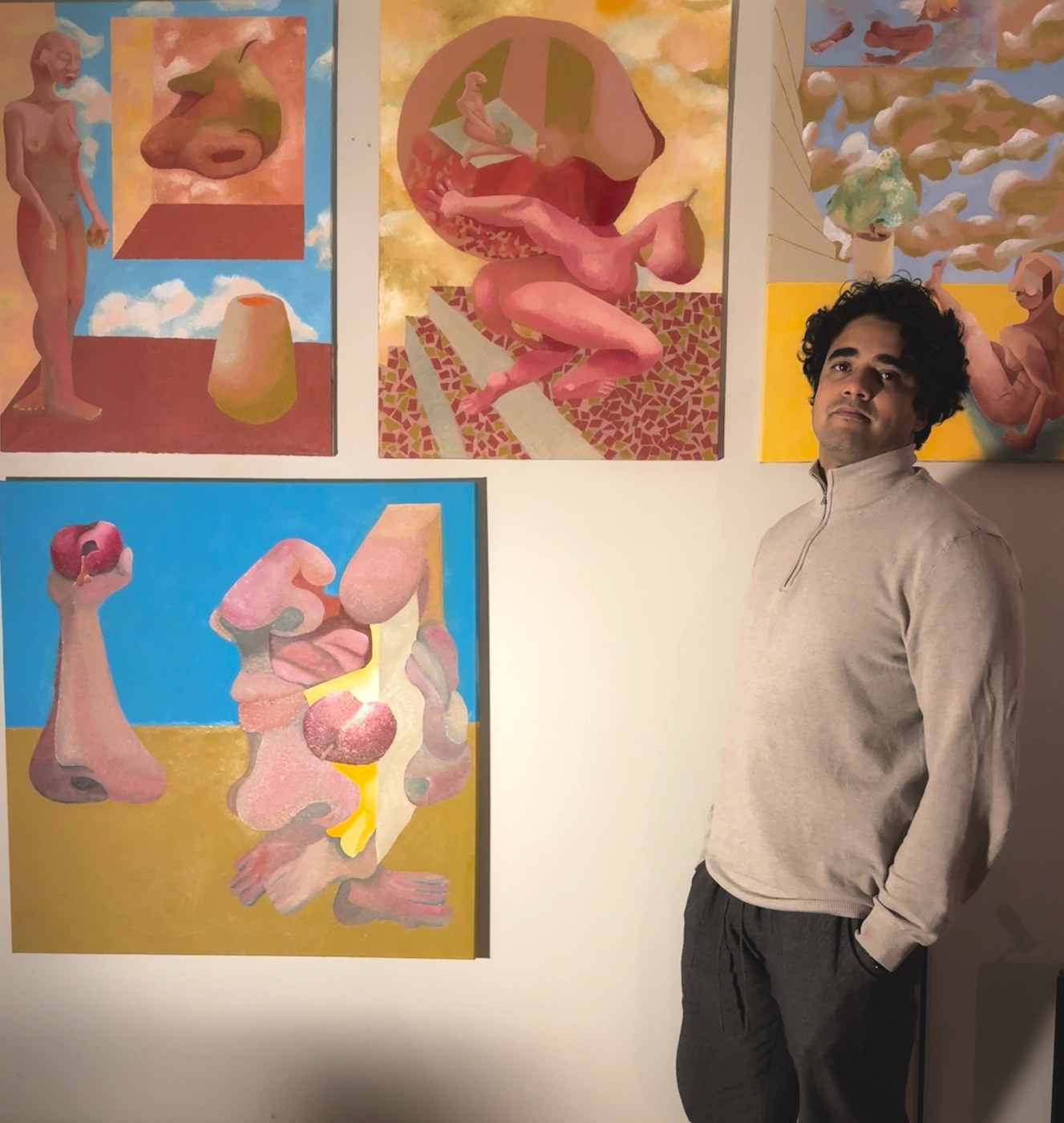
This tension enters directly into the structure of my compositions. I often introduce reduced entities (geometric structures, simplified objects, symbolic fragments, or sharply bounded shapes) that can be recognized as something familiar, acting as anchors within the image. Around them, however, color shifts the emotional register, scale becomes uncertain, context refuses closure, and the familiar form begins to drift. I am interested in what happens when a reduced form enters an environment that cannot be reduced with the same ease. The painting holds two regimes of sense-making at once: one moving toward identification, categorization, and clarity, and another remaining atmospheric, unstable, and resistant to immediate fixation. I often begin my works with free association, allowing forms to emerge before explanation fixes them too early, followed by a negotiation between control and release, deliberate construction and unforeseen emergence.